
Hiring temporary staff for a major exhibition at Pragati Maidan, a high-volume warehouse dispatch in Bilaspur, or a corporate summit in Gurgaon comes with tight deadlines and high stakes. Partnering with the wrong manpower service provider can quickly lead to no-show crews, compliance penalties, and damaged brand reputation.
The temporary staffing sector in Delhi NCR features a vast spectrum of providers—from compliant, tech-enabled enterprise agencies to informal, fly-by-night brokers operating on WhatsApp groups. Recognizing operational and legal red flags before signing a contract ensures your on-ground operations run smoothly and legally.
Table of Contents
- The High Cost of Poor Staffing Decisions
- 10 Red Flags When Evaluating a Manpower Service Agency
- Statutory Compliance & Legal Checklist for Delhi NCR
- Agency Evaluation Matrix
- Vetting Questions to Ask Before Signing
- Frequently Asked Questions (FAQs)
1. The High Cost of Poor Staffing Decisions
In the fast-paced business corridors of Delhi, Noida, and Gurgaon, operational continuity depends on dependable staff. When a temporary manpower service agency fails to deliver, the hidden costs accumulate rapidly:
- Operational Bottlenecks: Understaffed registration desks, delayed warehouse turnarounds, and unattended customer booths.
- Legal & Statutory Exposure: In India, the principal employer can be held liable under the Contract Labour (Regulation and Abolition) Act if the staffing agency defaults on statutory dues like PF, ESIC, or minimum wages.
- Brand Erosion: Unvetted, poorly groomed, or untrained personnel directly interfacing with your premium clients or VIP guests.
2. 10 Red Flags When Evaluating a Manpower Service Agency
1. Quotes That Fall Below Statutory Minimum Wages
If an agency quotes a daily billing rate that is lower than the statutory minimum wage published by the respective state labor department (Delhi NCT, Haryana, or Uttar Pradesh), walk away immediately.
To offer these rates, the vendor is either underpaying workers (risking labor strikes and legal scrutiny) or planning to inflate final invoices with unexpected hidden charges.
2. Inability to Provide Active PF, ESIC, and GST Registration Details
A professional manpower service must be registered with the Employees’ Provident Fund Organisation (EPFO), Employees’ State Insurance Corporation (ESIC), and Goods and Services Tax (GST) authorities.
Agencies that hesitate to furnish registration numbers, or those operating exclusively on cash payments and informal UPI transfers, expose your business to severe joint-liability risks as a principal employer.
3. Absence of a Formal Contract Labour (CLRA) License
Under the Contract Labour (Regulation and Abolition) Act, 1970, any staffing agency deploying 20 or more contractual workers (or state-specific threshold limits) must hold a valid labor contractor license from the licensing officer of the respective jurisdiction.
Operating without this license is a statutory violation across Delhi, Haryana, and UP.
4. No Guaranteed Buffer or Replacement Policy
Contractual staffing in large metropolitan areas faces average absenteeism rates of 10% to 20% due to transit disruptions, illness, or last-minute dropping out.
A reliable agency always maintains a 10% to 15% standby reserve on call. If an agency cannot commit in writing to a 60-to-90-minute replacement guarantee for absent personnel, you risk being short-staffed on event day.
5. Lack of a Structured Screening and Vetting Process
Ask the vendor: How do you source your staff?
If their recruitment pipeline relies solely on unverified broadcast groups without identity verification (Aadhaar/e-KYC), criminal background checks, or language assessments, you risk placing unvetted individuals in sensitive corporate or retail environments.
6. Reluctance to Provide Verifiable Client References in NCR
Established staffing agencies readily share verifiable case studies or corporate references from past projects in Aerocity, Cyber Hub, or Greater Noida Expo Mart.
Vague claims like “we work with all top MNCs” without named references, signed work orders, or verifiable project history indicate an unproven broker.
7. Vague Shift Definitions and Hidden Overtime Clauses
A reputable agency clearly defines standard shift hours (typically 8 to 9 hours, inclusive of a lunch break) and pre-agrees on hourly overtime (OT) rates.
Be cautious of contracts with ambiguous working-hour terms; unscrupulous agencies often bill unexpected 1.5x or 2x surge charges for minor schedule overruns.
8. No Dedicated On-Site Supervisor for Large Deployments
Deploying 10 or more temporary workers without on-ground leadership leads to operational confusion.
If an agency expects your internal team to handle daily attendance, briefing, uniform checks, meal rotations, and grievance handling without providing an assigned supervisor, they are acting as a simple body-broker rather than a managed manpower service.
9. Demanding 100% Upfront Advance Payment
While standard industry practices involve a mobilization deposit (usually 20% to 50% for one-off events, or post-dated monthly billing cycles for corporate contracts), demanding 100% upfront cash payment before staff deployment is a critical warning sign.
It removes the agency’s incentive to resolve on-site staffing disputes or replace underperforming personnel.
10. Lack of Standardized Uniforms or Grooming Protocols
Frontline brand representatives, ushers, and promotional staff require standard dress codes (e.g., matching black formal suits, branded polo shirts, or high-visibility safety vests for industrial settings).
If an agency leaves dress codes entirely to individual staff discretion without quality control, your brand presentation will be inconsistent.
3. Statutory Compliance & Legal Checklist for Delhi NCR
Before onboarding any temporary staffing agency, audit their compliance against these four statutory pillars:
- State Minimum Wage Compliance: Ensure wages match current semi-skilled/skilled notifications for Delhi NCT, Haryana (Gurgaon/Faridabad), or Uttar Pradesh (Noida/Greater Noida).
- EPF & ESIC Challans: Demand monthly Electronic Challan cum Return (ECR) receipts to confirm social security deductions are actively deposited.
- Contract Labour Regulation Act (CLRA): Verify Form VI (License) from the agency and ensure your company maintains Form V (Form of Certificate by Principal Employer).
- GST Compliance: Verify the agency’s GSTIN on the official GST portal to confirm active filing status and avoid input tax credit (ITC) blockages.
4. Agency Evaluation Matrix
Use this scoring framework to compare prospective staffing agencies before issuing a purchase order:
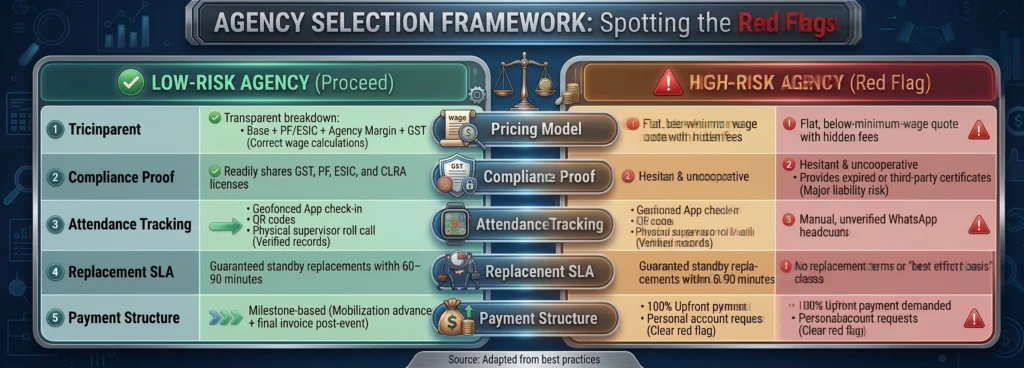
| Evaluation Criteria | Low-Risk Agency (Proceed) | High-Risk Agency (Red Flag) |
| Pricing Model | Transparent (Base + PF/ESIC + Agency Margin + GST) | Flat, below-minimum-wage quote with hidden fees |
| Compliance Proof | Readily shares GST, PF, ESIC, and CLRA licenses | Hesitant, provides expired or third-party certificates |
| Attendance Tracking | Geofenced app, QR check-in, or physical supervisor roll call | Manual, unverified WhatsApp headcounts |
| Replacement SLA | Guaranteed standby replacements within 60–90 minutes | No replacement terms or “best effort basis” clause |
| Payment Structure | Milestone-based (Mobilization advance + final invoice post-event) | 100% upfront payment demanded via personal accounts |
5. Vetting Questions to Ask Before Signing
Before entering into a service agreement with a temporary manpower service in Delhi NCR, ensure your procurement team asks these essential questions:
- “Can you provide your latest monthly EPF and ESIC payment receipts for your deployed workforce?”
- “What is your documented process for background verification and identity checks?”
- “Do you provide an on-site supervisor, and at what staff-to-supervisor ratio?”
- “How many standby crew members are allocated to our venue in case of morning no-shows?”
- “How do you handle transport and safety drops for shifts extending past 10:00 PM?”
6. Frequently Asked Questions (FAQs)
What is the most critical red flag when hiring a manpower service agency?
The most critical red flag is a quote that falls below the state’s statutory minimum wage. This almost always indicates illegal wage undercutting, non-payment of mandatory PF/ESIC contributions, or imminent billing fraud.
Can our company be held liable if a temporary staffing agency violates labor laws?
Yes. Under Indian labor jurisprudence and the Contract Labour (Regulation and Abolition) Act, the principal employer remains secondary-liable for statutory compliance, unpaid wages, and accident compensations if the primary contractor defaults.
What is an acceptable standby buffer for event staffing in Delhi NCR?
A reputable agency should provide an active standby buffer of 10% to 15% of the total deployed headcount to seamlessly replace late arrivals or underperforming staff without disrupting operations.
Do temporary staffing agencies in Delhi NCR handle night transport for female workers?
Compliant agencies must adhere to regional safety mandates, providing verified cab transport or security escorts for shifts extending past standard night thresholds (typically past 8:00 PM / 10:00 PM depending on state jurisdiction).
Get Fully Compliant Temporary Manpower in Delhi NCR
Don’t let unreliable staffing compromise your brand reputation, venue logistics, or legal compliance. Partner with a transparent, fully licensed staffing team backed by background-verified personnel, real-time supervision, and strict statutory compliance across Delhi, Gurgaon, and Noida.
Request a verified staffing proposal and customized rate card for your upcoming project today.